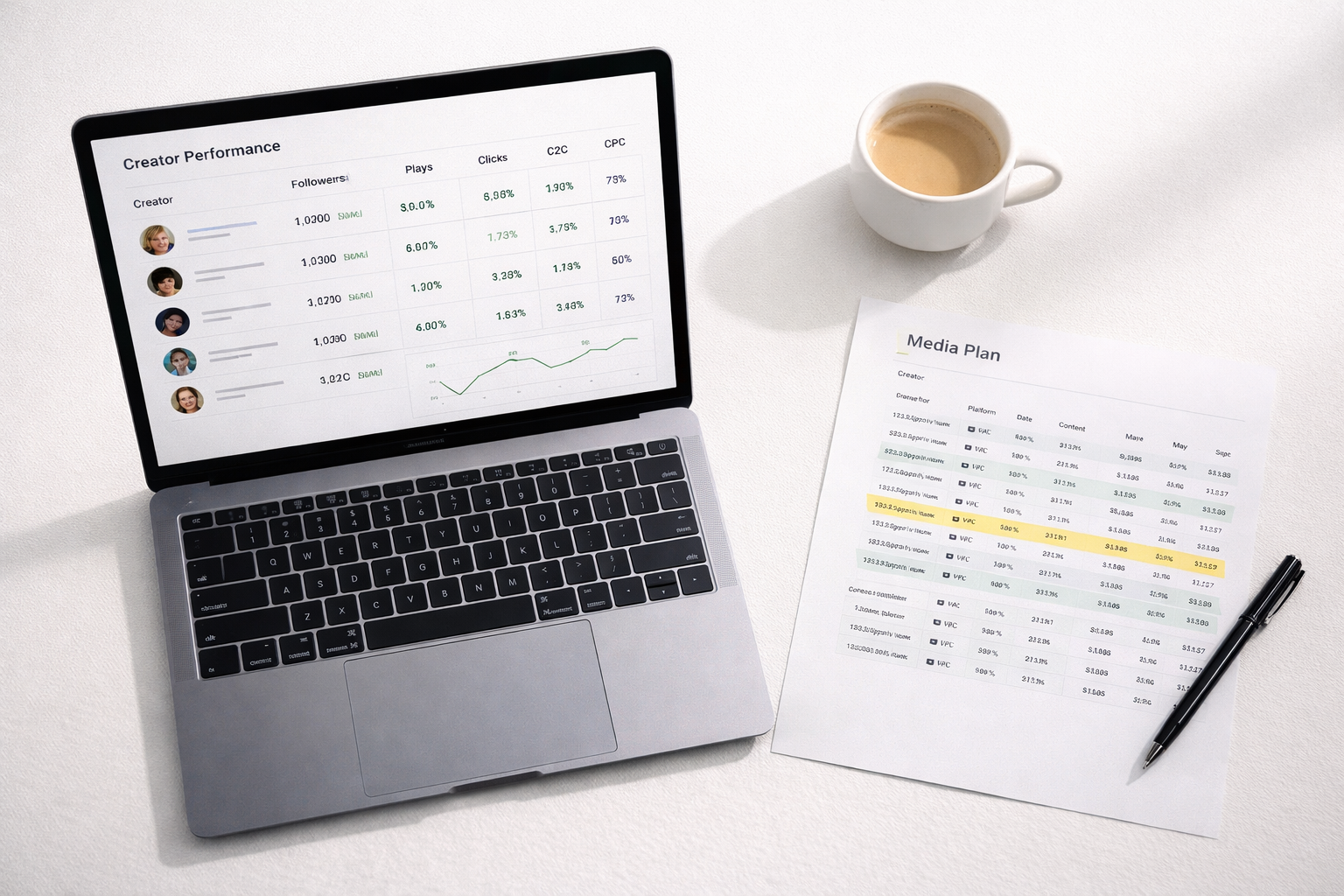
What is influencer marketing? The definition
Influencer marketing is a marketing strategy in which brands work with people who have built up an engaged follower base on social media platforms to authentically communicate products, services, or brand messages. In contrast to traditional advertising, influencer marketing is based on the trust that creators have built with their community. Followers do not perceive recommendations from influencers as advertising — but as a personal opinion. That is exactly what makes the difference in the purchase decision.
The basic principle is not new. Word-of-mouth marketing has existed for decades. What has fundamentally changed is scalability and measurability. Modern influencer campaigns can be managed with the same KPIs as performance marketing: CPM, CPC, ROAS and customer acquisition cost are now standard metrics in professionally set up creator programs. Anyone who still regards influencer marketing as a “soft” branding tool is missing out on the strategic core of the discipline.
One important aspect is often underestimated: Influencer marketing is no substitute for existing channels. It reaches target groups incrementally — people who cannot be reached via traditional channels at all or can only be reached at significantly higher costs. A study by TapInfluence and Nielsen Catalina Solutions shows that influencer marketing generates an incremental increase in sales of 10 percent and delivers 11 times the ROI compared to traditional forms of advertising. It's about real range expansion, not channel substitution.
The 4 types of influencers and what influencer marketing can really do
The industry distinguishes between four main categories of influencers — primarily by reach, but also by engagement rate, niche relevance and cost structure. Nano influencers have between 1,000 and 10,000 followers, achieve the highest engagement rates with an average of 5 to 8 percent and are particularly strong in tight communities. Micro influencers with 10,000 to 100,000 followers combine niche expertise with solid reach and achieve the lowest CPE in most industries. Macro influencers with between 100,000 and one million followers offer scalability while maintaining high credibility. Mega influencers with over one million followers are suitable for branding campaigns with clearly defined reach goals, but have the broadest and therefore most heterogeneous target group.
What practice shows: Neither a dogmatic focus on small influencers nor on big names leads to optimal results. A diversified creator portfolio, which strategically combines different size classes, consistently beats both individual approaches. The optimal mix depends on campaign goal, product category and available budget — and changes as the program matures. What makes sense in an early testing phase is significantly different from what works in a scaled setup. Choosing the right creator portfolio is not a one-time decision, but a continuous process.
Influencer marketing strategy: How to build a successful campaign
A professionally implemented influencer campaign follows a clearly defined process that begins well before creator selection. The first and most important step is to define goals. Awareness, consideration, and conversion are fundamentally different goals that require different types of influencers, platforms, and content formats. An awareness campaign prioritizes reach and impressions. A conversion campaign needs creators with whitelisting permission, trackable links, and content that works directly towards a CTA.
The second step is creator selection — and here, reach alone is not a valid criterion. Relevant metrics include audience demographics, engagement rate, brand safety score, content quality, and historical campaign performance. One mistake that is often underestimated is too strict brand fit selection. If more than 60 to 70 percent of suggested creators are rejected for brand reasons, the remaining selection becomes too homogeneous — and often too poorly performing. The creators who convert the most often also polarize. Criteria that are too strict preclude exactly this.
Briefing is the third critical lever. Effective briefings provide clear brand messages and mandatory disclosures without limiting the creator's creative freedom. Requirements that are too rigid reduce authenticity — and therefore conversion rates. Content that feels like advertising performs worse than content that sounds like the creator's opinion.
The fourth step is to run the campaign. Creator whitelisting — the placement of paid ads via the influencer's account instead of via the brand account — is now standard for performance-oriented campaigns. It allows precise targeting, A/B testing of creatives, and clean attribution. Without a paid extension, a significant portion of the performance potential remains unused. Professionally set up programs treat Paid Extension not as an optional add-on, but as a fixed system component: Organic collaborations are broadcast, the best performers are identified and then systematically continued as paid ads.
Measuring influencer marketing ROI: Comparing attribution models
One of the most common mistakes in influencer programs is incorrect attribution. Last-click models systematically underestimate the value of influencer content because the customer journey comprises multiple touchpoints. A user sees a TikTok video from a creator, then researches on Google and converts via a paid search ad. In the last-click model, Search is credited with the entire conversion — the influencer content that triggered the process appears worthless. This picture is distorted and leads to incorrect budget decisions.
Data-driven multi-touch attribution distributes the conversion value across all touchpoints, weighted according to actual influence on the purchase decision. The model requires sufficient data volume, but provides the most realistic impact representation. For channels with weak digital trackability — YouTube, podcasts, organic social posts — the post-purchase survey is the most valuable additional data point.
The granularity of tracking is decisive. The difference between “influencer marketing generated 200 leads” and “Creator A generated 45 leads, including 8 deals; Creator B generated 120 leads, including 6 deals” is fundamental. It is only at the cooperation level that it is visible which creator types, formats and messages actually lead to conversion. Anyone who only has aggregated data optimizes blindly. Programs that implement granular tracking from the start demonstrably improve their KPIs faster than those that set up measurement systems retrospectively.
Scaling influencer marketing: Why building up takes time
One of the most common reasons why influencer programs fail is because of unrealistic expectations. A new channel is compared directly with channels that have been optimized for years, such as search engine marketing — and declared too expensive when compared for the first time. This assessment is structurally incorrect.
Influencer marketing as a performance discipline typically takes 12 to 18 months to build up to real profitability. During this time, creator types are tested, formats optimized, tracking infrastructure set up and processes imported. The first goal of a pilot phase is not immediate profitability — but reliable evidence that the channel is working and initial hypotheses about what works best.
Programs that are aborted too early often fail not because of a lack of effect, but because the test volume is too low. Fewer than 15 collaborations do not provide any statistically reliable findings — the variability of individual collaborations is too high to draw valid conclusions. Patterns that enable real optimization decisions can only be seen when there is a sufficient portfolio.
The time windows are closing more and more. Creators with a high affinity for relevant target groups are a limited resource. Early programs gain access and cooperation experience with the best creators — an advantage that increases with every optimization phase and makes it difficult for the competitor to catch up with later on.
Influencer marketing for B2B: An underrated discipline
B2B influencer marketing is structurally different from B2C. The central question is not who has the most followers, but who enjoys the highest level of trust among the relevant target group — decision makers and professionals. A thought leader on LinkedIn with 15,000 followers from the HR sector has more leverage for an HR SaaS brand than a lifestyle influencer with one million followers.
The most effective B2B creators are subject matter experts with recognizable opinions and specific expertise. Their reach is smaller, but their target group affinity is significantly higher. LinkedIn is the primary platform for B2B influencer marketing in Germany, supplemented by YouTube for deep-dive content and podcasts for research-intensive categories. B2B companies that plan influencer marketing with a time horizon of 12 to 18 months and rely on long-term creator partnerships instead of selective campaigns consistently achieve better pipeline results than short-term competitors.
Influencer marketing trends: What is shaping the market in 2026 and beyond
The market for influencer marketing is changing faster than most other marketing disciplines. The trends that dominate 2026 are not short-term phenomena — they are structurally shifting how creator programs are set up, measured, and scaled.
AI-based creator selection is no longer an issue of the future. Platforms such as Modash and Grin use machine learning to calculate audience overlap, brand safety scores, and predicted performance. In larger creator programs, manual selection is increasingly being supplemented by data-driven shortlists — which increases efficiency and reduces incorrect decisions.
Performance-based compensation models are prevailing. Pure pay-per-post agreements are losing importance. Hybrid models of basic fee and performance bonus based on CPM, CPA or revenue share improve the incentive structure for both sides and sustainably increase the quality of cooperation.
Long-form content on YouTube and in podcasts is becoming increasingly important again. Short content dominates attention, but long-form formats achieve higher conversion rates in several categories — Finance, Tech, Health. A 10-minute YouTube review has a longer half-life and higher purchase intent effect than a 30-second reel. Brands that rely exclusively on short form optimize for reach, not for conversion.
Regulating influencer collaborations is no longer a side issue. Since the 2021 Federal Court of Justice ruling, labelling requirements for commercial cooperation in Germany have been clearly regulated. Non-labeling is not a calculable risk — professional creators and agencies now set disclosure standards as a standard part of the contract.
Do I need an influencer marketing agency?
For smaller campaigns with one to three influencers, an in-house approach is generally feasible. Starting at a certain program size — more than five parallel creator collaborations, whitelisting, multi-channel, international scope — a specialized influencer marketing agency is more efficient. It brings with it creator databases, contract standards, attribution infrastructure, and cross-campaign experience that can only be replicated internally with considerable effort.
The decisive selection factor when choosing an influencer marketing agency is not the size of the creator network — but the performance framework. An agency that sees creator programs as an awareness tool and does not have a clear attribution strategy does not deliver demonstrable results in most cases. If you want to treat influencer marketing as a growth channel, you need a partner who thinks the same way.
At Altitude, we set up influencer programs as an integrated part of the performance funnel right from the start — with data-based creator selection, whitelisting strategy, and multi-touch attribution. We explain the approach behind this on our Influencer marketing agency page.
Most influencer programs fail not because influencer marketing isn't working — but because they're canceled too early, haven't tested enough, or never built the infrastructure to really understand what's working. Influencer marketing is not a sprint. It is a channel that grows the more systematically you operate it — and that can compete with any other performance channel in the long term if it is set up professionally.
Lucas Bast, Founder & CMO, altitude
35 + Jahre
Growth Erfahrung
FAQ — Frequently asked questions about influencer marketing
What is influencer marketing simply explained?
Influencer marketing is a strategy in which brands work with social media personalities who have built an engaged community. These creators recommend products or services in a way that is perceived as a personal opinion — not as traditional advertising. This increases credibility and conversion rate compared to conventional formats.
How much does influencer marketing cost?
Costs vary widely by influencer type, platform, and campaign goal. Micro influencers start from 500 to 2,000 euros per post, macro influencers are typically 5,000 to 50,000 euros per collaboration. It is not the absolute price that is decisive, but the CPE and ROAS compared to alternative channels.
How do you measure the success of influencer marketing?
Professional campaigns combine platform analytics, UTM tracking, discount codes, and post-purchase surveys. Granular tracking at cooperation level — not aggregated overall KPIs — is crucial. Multi-touch attribution provides the more realistic image compared to last-click models.
What is the difference between micro and macro influencers?
Micro influencers have 10,000 to 100,000 followers, achieve higher engagement rates and specialize in niches. Macro influencers offer more reach but a wider target group. A diversified mix of both types achieves the best results in practice.
Why do many influencer pilot projects fail?
The most common reasons: too low test volumes (less than 15 collaborations provide no valid findings), unrealistic expectations of immediate profitability, lack of tracking infrastructure and overly strict brand fit criteria. Influencer marketing takes 12 to 18 months to set up — just like any other new performance channel.
Does influencer marketing also make sense for B2B companies?
Yes B2B influencer marketing on LinkedIn, YouTube and in specialist podcasts is growing rapidly. Subject matter experts with 5,000 to 50,000 followers often achieve higher pipeline impact than broad-based campaigns. Creators' target group affinity is decisive — not the absolute number of followers.
Which platforms are suitable for influencer marketing?
Instagram and TikTok dominate B2C campaigns. YouTube is suitable for research-intensive categories such as finance, tech, and health. LinkedIn is the most important platform for B2B. The choice of platform should always be based on the target group — not on the current trend discussion.
- TapInfluence / Nielsen Catalina Solutions: The Power of Influencer Marketing — Studie zur inkrementellen Umsatzwirkung und ROI-Vergleich mit traditionellen Werbeformen. https://www.marketingdive.com/news/influencer-marketing-spurs-11-times-the-roi-over-traditional-tactics-study/416911/
- Nielsen (2022): Trust in Advertising — Studie zur Glaubwürdigkeit von Empfehlungen durch Creator vs. klassische Werbung. https://www.nielsen.com/insights/2022/trust-in-advertising/
- Bundesgerichtshof (2021): Urteil zur Kennzeichnungspflicht bei Influencer-Werbung (Az. I ZR 90/20) — maßgebendes Urteil zur Disclosure-Pflicht in Deutschland. https://www.bundesgerichtshof.de/
- ARD/ZDF-Onlinestudie (2024): Mediennutzung im Intermediavergleich — Daten zur täglichen Nutzungsdauer von Online-Video bei 14–29-Jährigen. https://www.ard-zdf-onlinestudie.de/